
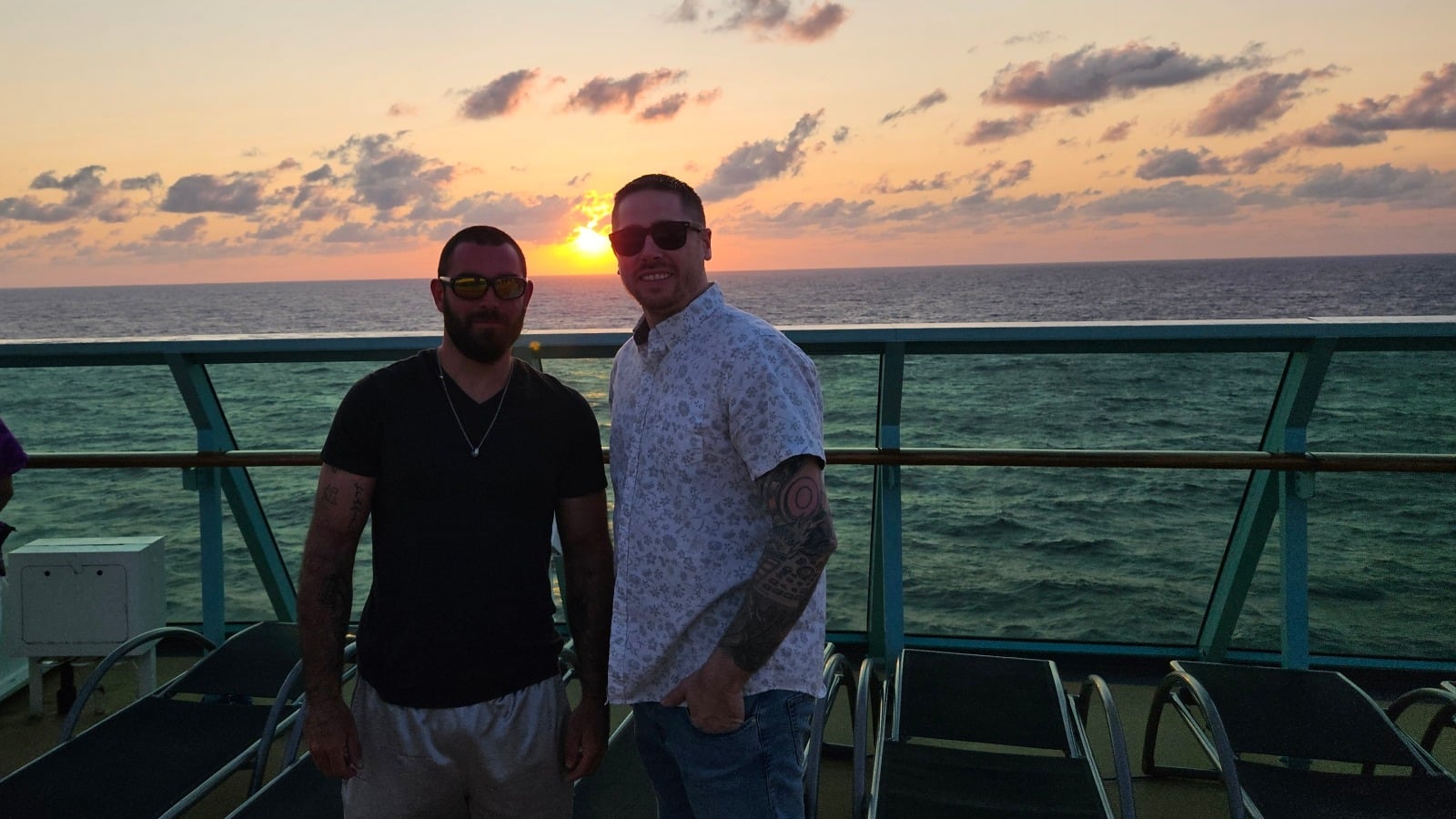
Embarkation day is supposed to be the simple part. You show up, you walk on, the holiday starts. Most first-timers don’t realize that half of the day has already happened before they ever leave home, and the other half has a few moving parts that catch people off guard every single sailing.
The good news is that none of it is hard. You just need to know what’s coming. This guide walks through the whole day in order: from the online check-in window you don’t want to miss, through the documents that can get you turned away at the pier, all the way to the moment the ship pulls away from the dock. We’ve sailed once, we’re booked twice more, and we’ve spent enough time in Royal Caribbean’s app and at the Cruise Maryland Terminal in Baltimore to know where the friction points are.
Online Check-In Isn’t Optional Anymore
Every major cruise line now requires online check-in before you arrive at the pier. You can technically still board if you haven’t done it, but you’ll spend an extra 30 to 60 minutes at the terminal completing it manually while everyone else walks onto the ship.
The bigger reason to do it the moment your window opens, though, isn’t the time savings on boarding day. It’s that the same process is where you pick your arrival time slot, and the earliest slots disappear fast. If you want to be one of the first guests on board (more on why you’d want that later), you need to be ready when your window opens.
Each line’s window opens at a different point before sailing. Here’s where they currently stand:
| Cruise Line | Check-In Window Opens | Notes |
|---|---|---|
| Princess | 60 days before sailing | Earliest window of the major lines |
| Royal Caribbean | 45 days | App-preferred; arrival slots open at midnight port time |
| Celebrity | 45 days | Must be completed at least 3 days before sailing |
| Holland America | 30 days | Boarding times are typically assigned rather than chosen |
| MSC | 30 days | Must be completed at least 24 hours before sailing |
| Norwegian | 21 days | Closes 72 hours before sailing |
| Carnival | 14 days | 16 days for Diamond and Platinum loyalty members |
(Sources: each cruise line’s official website, verified May 2026.)
Royal Caribbean opens its arrival slots at midnight in the time zone of your departure port. From the big Florida homeports in peak season, those slots get snapped up overnight, so an alarm and a quick check at midnight is worth it. From smaller homeports like Baltimore, you’ll usually find perfectly fine slots the next morning without setting an alarm.
Tip: Once your boarding pass is ready, screenshot it and save the screenshot to your phone’s photos. Cruise terminal Wi-Fi is unreliable, and you don’t want to be fumbling with a loading spinner at the check-in agent’s desk.
Boarding Time Versus Arrival Time (They’re Not The Same)
This is the single most common first-timer mix-up. Your boarding time is the window the cruise line wants you to physically arrive at the terminal. It’s not the time you should leave your hotel, not the time you should park, and definitely not the time the ship leaves.
There’s also a separate cut-off you need to know about. Almost every major cruise line requires you to be checked in and on board at least 90 minutes before the ship’s scheduled sailing time. Roll up after that and there’s a real chance you’ll be denied boarding entirely. The ship doesn’t wait, and the cruise line doesn’t owe you anything if you miss it.

For more on the small mistakes that can blow up a cruise before it starts, we’ve covered the biggest first-timer booking mistakes here.
Heads up: If your cruise leaves at 4pm, you need to be checked in by 2:30pm at the absolute latest. Build buffer time for parking, traffic, security, and the queue. And fly into your homeport city the day before sailing, not the morning of. Flight delays don’t get the ship to wait.
What You’ll Need Ready Before You Check In
The actual check-in form takes 15 to 20 minutes once you’ve got everything together. Pulling it all up first saves you from bouncing between apps mid-process.
You’ll need:
- Your passport (or birth certificate plus government-issued photo ID, depending on your itinerary)
- A clear, well-lit photo of yourself for the security pass (most lines walk you through this in the app)
- A credit or debit card for your onboard expense account
- The name, phone number, and email of an emergency contact who isn’t traveling with you
- Your booking confirmation number
The single most important thing before you submit anything: check that the names and birth dates on your booking match your travel documents exactly. A typo on a middle name, a transposed digit in a birth date, small errors that take five minutes to fix two months out and become a real problem at the terminal on the day.

Photo by DΛVΞ GΛRCIΛ on Pexels
Most cruise lines now strongly prefer the mobile app over their website for check-in. The app makes the photo upload and document scan smoother, and on Royal Caribbean the digital boarding pass works most reliably through the app anyway. Download the latest version of whatever app applies to your line before you start.
I’d also bring a printed boarding pass as a backup. Carnival accepts both printed and mobile passes (which contradicts some older guides claiming printed is required), and Royal Caribbean and Norwegian work fine off the app for most guests. But printer-and-phone redundancy costs you nothing, and dead batteries at the worst possible moment are a real thing.
Documents That Can Get You Turned Away
This is the section that genuinely matters. Getting denied boarding because of a documentation issue is rare, but the people it happens to didn’t see it coming either.
Passport Validity
If you’re using a passport, it needs to be valid for at least six months beyond your cruise’s return date. This isn’t a cruise line rule. It’s a requirement enforced by many of the countries the ship visits. A passport that expires three months after your return is treated as not valid for travel. Check the expiration date now and renew if you’re inside that six-month window.
Cruising Without A Passport
US citizens on closed-loop cruises (sailings that depart from and return to the same US port) can technically board with a state-issued birth certificate plus a government-issued photo ID. This works for most Caribbean, Bahamas, Bermuda, Mexico, and Alaska itineraries.
A few important caveats. Hospital birth certificates and baptismal certificates don’t count; it needs to be the original or a certified copy issued by your state’s vital records office. Some destinations, including Panama, Colombia, Martinique, Barbados, Guadeloupe, Haiti, St. Barts, and Trinidad and Tobago, may still require a passport for shore visits or won’t allow closed-loop boarding at all. And every cruise line strongly recommends carrying a passport anyway, because if you miss the ship in a foreign port or need a medical evacuation home, you can’t fly internationally without one.
Visa Changes For 2026
The biggest documentation change in the last year affects anyone whose cruise touches the UK. Full enforcement of the UK’s Electronic Travel Authorisation (ETA) began on February 25, 2026. US, Canadian, EU, and most other non-visa nationals (including children) now need a valid ETA before boarding any cruise that embarks from, disembarks at, or even calls at a UK port.
The application is digital, processed within roughly three working days, and currently costs £20. Apply through the official UK government website (gov.uk), not a third-party site charging a markup. The ETA is linked to the specific passport you applied with and stays valid for two years or until that passport expires, whichever comes first. Carriers can refuse to board you if you don’t have one.
If you’re traveling with a child who isn’t yours (a grandchild, a niece, a friend’s kid), you may also need a notarized consent letter from their parent or legal guardian. Requirements vary by line and itinerary, so check with the cruise line in advance.
Heads up: Never put your passport, birth certificate, or any travel documents in checked luggage. Checked bags go with the porters at the curb and don’t make it to your cabin until late afternoon. Documents stay on you, in a carry-on, or in a passport wallet.
What To Pack In Your Embarkation Day Bag
Your checked luggage will be collected by porters at the terminal and delivered to your cabin sometime between mid-afternoon and dinner. That means your carry-on is the only bag you’ll have for the first four to six hours on board. Plan it accordingly.

The non-negotiable items for the carry-on:
- All travel documents (passport, boarding pass, IDs)
- Medications, especially anything prescribed
- A change of clothes in case your luggage gets delayed
- Swimsuit and a cover-up (more on why in a minute)
- Phone, charger, and any cables you need
- Any valuables you’d hate to lose: jewelry, electronics, cash
A few smaller things worth including: a refillable water bottle for the terminal queue, a light jacket if you’re sensitive to ship air conditioning, and any prescription documentation in case you’re questioned about medications at security. If you want a fuller list of what works as a carry-on versus checked, our cruise packing guide covers the trade-offs in more detail.
One thing to know about porters: in North American ports, it’s customary to tip the porter who handles your bags a couple of dollars per bag. Have a few small bills ready before you hand anything over. The full breakdown of cruise tipping etiquette is here.
What Actually Happens At The Terminal
Expect a queue. Sometimes a short one, sometimes a longer one, depending on the port and the time slot. In our experience, the line moved quickly and the whole process took under 30 minutes from handing bags to porters to walking up the gangway.
The flow goes something like this. First the porters take your checked luggage at the curb. Then you walk into the terminal building and through a security screening, which works like a streamlined airport process: bags through an X-ray scanner, you through a metal detector. Then you queue for the check-in desk, where an agent verifies your ID, scans your boarding pass, and may ask to see the credit card linked to your onboard account.
There’s a short health questionnaire at the desk, nothing like the pandemic-era screenings. A few questions about whether you’ve had vomiting or diarrhea recently, mostly aimed at catching norovirus before it boards the ship. No vaccine requirements at the major lines as of this writing.
Once you’re cleared, you walk to the gangway, scan your pass one final time, and you’re on the ship.
What we learned: On our June 2025 Vision of the Seas sailing out of Cruise Maryland Terminal in Baltimore, we expected the worst because we’d never done embarkation before. We were walking up the gangway about 20 minutes after pulling into the parking lot. Cruisers commonly report that smaller homeports move through embarkation faster than the Florida megaports, which is something to factor in if you’re choosing between sailings.
The First Hour On The Ship
Boarding day moves fast and there’s more to do than people realize. A rough plan helps.
- Get your safety check-in done. The old “everyone on deck for muster” drill is gone at most major lines. You watch a short safety video in the app or on your stateroom TV, then briefly tap in at your assigned muster station. Doing it the moment you board means it’s not hanging over you for the rest of the afternoon.
- Drop your carry-on at your cabin if it’s ready. Cabins are sometimes available at boarding, sometimes not until 1pm or later. Either way, swing by, drop the bag, lock valuables in the safe, and head back out. But if your room isn’t available, keep your bag with you until your room is ready.
- Skip the buffet for embarkation lunch. The buffet will be the busiest place on the ship at noon on day one. Look for an included sit-down option (most ships open the MDR for embarkation-day lunch) or a casual venue like the pool grill. A less chaotic lunch is a much better start to the cruise.
- Lock in dining and show reservations. Most lines let you book these in advance through the app or Cruise Planner, but a few specialty restaurants and shows hold back inventory until boarding day. Get this done before the good time slots disappear.
- Use the pool while it’s quiet. Water slides, hot tubs, pools, and basically every on-deck amenity will be less busy on embarkation day than any other day of the cruise. This is the single best argument for grabbing the earliest possible arrival slot and packing a swimsuit in your carry-on. There are more cruise freebies and perks worth knowing about here.
Don’t Skip Sailaway
Sailaway is the moment the cruise actually starts. The horn sounds, the ship pulls away from the pier, and the shoreline starts to shrink. Most ships throw some kind of sailaway party on the pool deck, but the better experience is finding a spot on the aft of the ship and watching the wake stretch out behind you as the port disappears.

Even if you’ve been on the ship since 11am, even if you’ve already eaten and unpacked and explored, stop what you’re doing when the horn sounds. The whole point of getting on a cruise ship is what happens after it leaves the dock. You only get one sailaway per cruise. Don’t be belowdecks during it.
A Few More Things Worth Knowing
There’s a credit card hold worth mentioning. Most cruise lines authorize a hold against the card you put on file. Royal Caribbean’s is currently around $99.75, and Carnival’s runs $100 for cruises five days or shorter and $200 for longer ones. This isn’t a charge, it’s a pending authorization that drops off after a few business days. But it can briefly tie up funds, so don’t put your only debit card on file if your account is already running tight. There are a handful of other onboard costs first-timers don’t expect, and the credit card hold is one of them.
If your cruise touches the Caribbean, there’s also a list of things worth knowing before you sail, from what the included islands actually offer to how the weather pattern affects port days. Our 2026 Caribbean cruise prep guide covers the rest.
One last small thing: save the email confirmations for anything you’ve pre-purchased (drink packages, dining packages, excursions, onboard credit) in a folder you can access offline. If something doesn’t show up correctly on your account when you board, having the confirmation pulled up at guest services is the fastest way to fix it.
The Bottom Line For Embarkation Day
Embarkation day is genuinely simple once you know what’s coming. The work happens at home, weeks before you ever see the terminal. Get your online check-in done the moment your window opens, pick the earliest arrival slot you can live with, make sure every name and date on your booking matches your travel documents, sort any required visas like the UK ETA well ahead of sailing, and pack a carry-on that covers your first few hours on board.
Do that and the day itself is the easy part. You hand off your luggage, queue briefly, walk on, drop your bag, and the holiday starts.
Have you had a smooth embarkation day, or a stressful one? What’s the one thing you’d tell a first-time cruiser to do differently?