
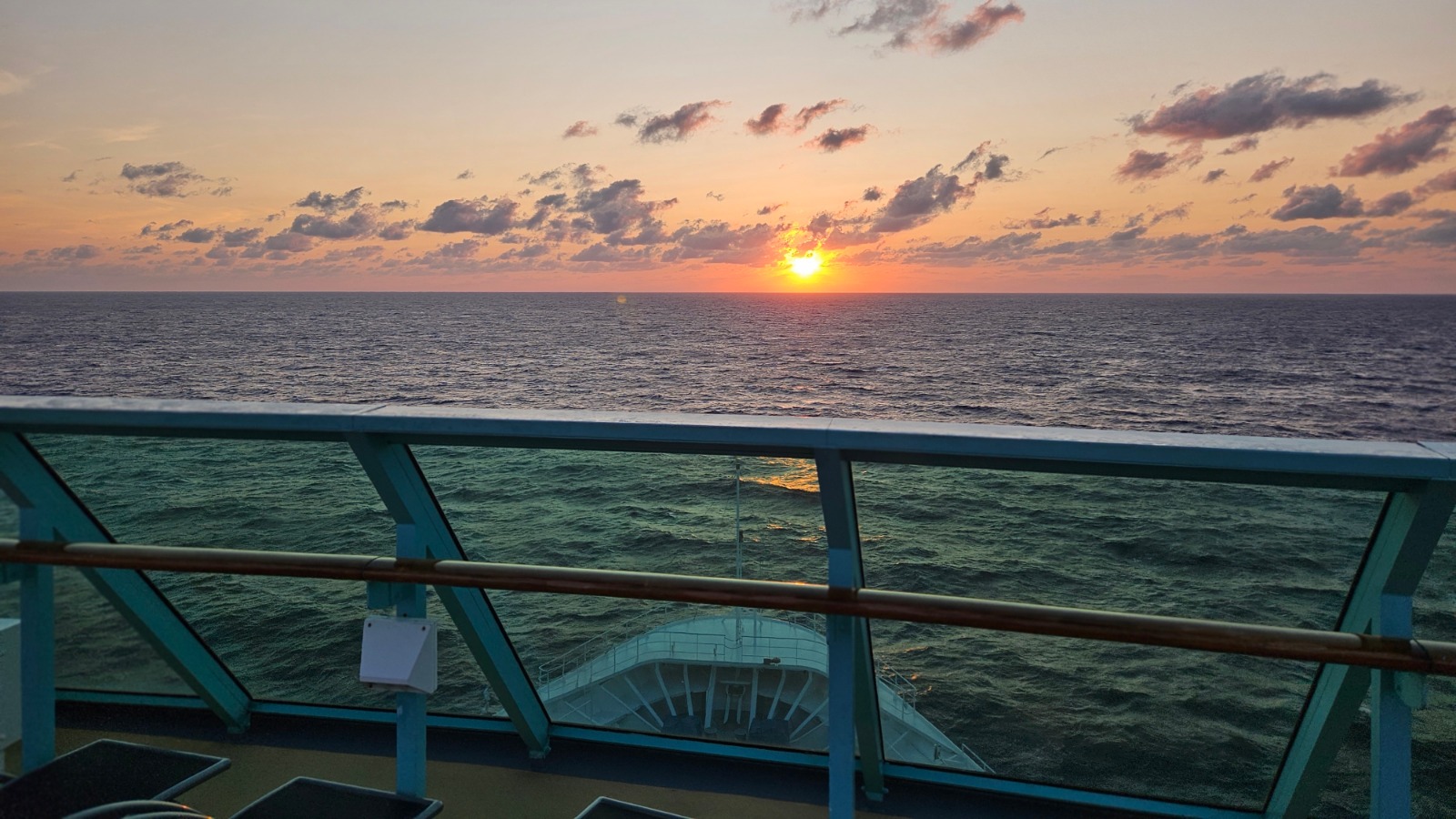
Booking your first cruise looks simple from the outside. Pick a ship, pick a week, click “book,” go pack a bag. Then you actually start trying to do it, and within ten minutes you’re staring at a comparison of fourteen different cabin categories on three different ships across two different cruise lines, with five different price quotes that don’t seem to include the same things. Somewhere in the middle of all of it, you’re wondering whether you’ve made a wrong turn.
We’ve been there. Our first cruise booking — Royal Caribbean’s Vision of the Seas, 5 nights to Bermuda out of Baltimore in May 2025 — took us about three weeks of false starts before we actually clicked deposit. Most of that was the two of us trying to figure out which questions we even needed to be asking.
This walkthrough is what I’d have wanted then: the actual order in which decisions get made when you book a cruise, what each one really means, where the hidden costs live, and the spots where it’s worth slowing down before you click.
Step 1: Figure Out What Kind Of Vacation You Actually Want
The mistake most first-time cruisers make isn’t picking the wrong ship. It’s picking a ship before they’ve decided what kind of vacation they’re really after.
Cruising can be a lot of different vacations. It can be a high-energy water-park-at-sea family week. It can be a slow, scenic glacier-watching trip. It can be a no-kids-allowed adults-only sail. It can be a foodie-focused week of specialty restaurants and wine pairings. The same seven days of vacation time gets you wildly different experiences depending on what you book.
This is where our framework for matching cruise type to vacation goals goes deeper, but the short version is that step one is sitting down — by yourself, with your partner, with whoever’s going — and answering some plain questions:
- Are we mostly here to relax, or mostly here to do stuff?
- How important is the destination versus the ship itself?
- How long can we be away — 4 nights, 7, 10?
- Are we okay flying to the port, or do we want to drive?
- Are there other people coming with us — kids, grandkids, friends?
- How much do we actually want to budget for this?
When Ryan and I worked through these for our first cruise, we wanted somewhere warm, didn’t want to fly, wanted something digestible for a first try (we settled on 5 nights), and wanted a real destination rather than just sea days. Bermuda from Baltimore answered all of that. Without that filter, we could have very easily ended up looking at a 7-night Caribbean out of Miami that would have meant flights, hotel nights, and a much bigger total cost — for a first cruise we weren’t even sure we’d love.

That’s worth doing on paper. If we’d skipped this step, the rest of the decisions would have been guesses.
Step 2: Set An Honest Budget — And Learn What’s Actually Included
The cruise fare you see advertised is not what your cruise will cost. Not even close.
Here’s what the fare typically does cover: your cabin, the main dining room (all meals), the buffet, room service for some basic items, the main pools and most public spaces, the kids’ clubs, the entertainment shows, the gym.
Here’s what it doesn’t cover, on most mainstream lines: gratuities (around $16 to $20 per person per night on most lines as of 2026 — you choose at booking whether to prepay them or not; if you skip prepaying, they get added to your onboard account daily and you can adjust or remove them there), drinks beyond water/coffee/tea/lemonade, Wi-Fi, specialty dining, shore excursions, casino, spa, photo packages, soda, premium coffee, port parking or pre-cruise hotel, and transportation to and from the port.
That second list adds up faster than first-time cruisers think.
What our 5-night Vision of the Seas sailing actually cost (May 2025):
Item Cost (for two) Cruise fare (oceanview cabin) $1,180 Gratuities $160 Wi-Fi (single device, surf only) $90 Specialty dining (one night, two people) $90 Pre-cruise hotel in Baltimore $185 Parking (5 days at port) $100 Total $1,805
That total doesn’t include drinks (we paid as we went, came in around $180 for the trip between us) or excursions in Bermuda (we did one paid beach day for around $90 between the two of us and kept the rest cheap with public buses and self-guided wandering). All-in, the trip ran around $2,100 for two people.
💡 Pro tip: Before you fall in love with a cruise fare, multiply it by 1.6 to 1.8 and ask yourself if you’d still book at that number. That rough multiplier is what most first-timers actually spend by the time gratuities, drinks, Wi-Fi, and basic extras get added in. If the answer is no, you need a cheaper cabin or a cheaper cruise.
We go deeper on this in our breakdown of the hidden costs of cruising — worth a read before you click deposit on anything.
Step 3: Pick A Cruise Line That Matches Who You Are
This is the step where the most first-time booking regret gets baked in. Pick the wrong line and the entire week feels off, no matter how nice the ship is.
The cruise lines are not interchangeable. They’re not even close. Each one has a personality, and matching that personality to yours is probably the single most important decision in this whole walkthrough.

A quick map of the mainstream lines, in our own words from what we’ve researched and (in Royal Caribbean’s case) experienced:
- Carnival. Fun, loud, party, casual, value. America’s cruise line. Best for first-timers on a budget, party crowds, families wanting to cut loose.
- Royal Caribbean. Adventure, innovation, mega-ship experiences. Best for families, active cruisers, anyone who wants the biggest ships at sea with surf simulators and ice rinks. This is what we know firsthand.
- Norwegian. Freestyle, flexible, no fixed dining times, casual. Best for cruisers who hate rigid schedules.
- MSC. European-flavored, modern, often a strong value. Best for Mediterranean itineraries or value-seekers.
- Princess. Refined, traditional, destination-focused. Consistently popular with the 55+ crowd, especially good for Alaska.
- Celebrity. Modern luxury, sophisticated, design-forward. Great for empty nesters, foodies, couples without kids.
- Holland America. Traditional, refined, older crowd, longer itineraries. Arguably the strongest fit for someone who wants the classic cruise experience.
If you want a deeper side-by-side of the two biggest mass-market lines, our Carnival versus Royal Caribbean comparison is the next read.
⚓ From our experience: We picked Royal Caribbean for our first cruise mostly because Vision of the Seas was sailing the itinerary we wanted, out of the port we wanted, on the dates we wanted. It worked out well — Royal felt like a balanced first-time choice, not the loudest party line but with plenty of activity if we wanted it. Ryan thinks we should branch out and try Carnival next for the contrast. I’m more inclined to do Celebrity or Princess. We’ll work it out.
Step 4: Pick The Destination, Length, And Ship Together
These three move as a unit. You can’t really pick one without the other two — the ship determines what destinations it sails, the destination usually dictates the length, and the length partly dictates which ships are options.
Destinations for a first cruise. The easiest first-time targets are Bahamas (3 to 4 nights from Florida, very low commitment, great for testing the waters), Caribbean (Eastern, Western, or Southern, usually 7 nights), Bermuda (5 to 7 nights from East Coast ports), Mexican Riviera (from West Coast), or Alaska in summer if budget allows.
Length. First cruises typically run anywhere from 3 to 7 nights. We ended up at 5, which felt about right. A 3-nighter would have been too short to settle into the rhythm. A 7-nighter for a first attempt felt like a big commitment if we ended up not liking cruising.
Ship size matters more than you’d guess. A mega-ship (4,000+ passengers) is its own destination — there’s so much to do onboard that the ports almost become bonus features. A mid-size ship (2,000 to 4,000) is the balanced sweet spot most cruisers land at. A smaller ship (under 2,000) feels more intimate but offers fewer activities and amenities.
Vision of the Seas, our ship, holds about 2,000 passengers and was launched in 1998. It’s one of the smaller ships in the Royal Caribbean fleet. We liked the smaller size for a first cruise: less walking, easier to figure out, less time waiting in lines. We’ve got Oasis of the Seas booked for June 2026, which holds over 5,400 passengers. That’s going to be a completely different experience, and that contrast is the whole reason we picked it as our second cruise.

📌 Worth knowing: Newer doesn’t always mean better. The newest mega-ships have the most amenities, but they also have the highest fares and the most crowds. An older, mid-size ship sailing a great itinerary is often a better first-cruise pick than a brand-new mega-ship on a mediocre route.
Step 5: Pick Your Cabin
Cabins are where cruise fares actually live. The ship doesn’t really care which cabin you pick, but you will, because the price gaps are large and the experience differences are real.
The four broad categories on most ships:
- Inside. No window, smallest, cheapest, sleeps the darkest. Works for cruisers who treat the cabin as a place to sleep and shower, nothing more.
- Oceanview. Has a window or porthole, slightly bigger, typically $200 to $500 more than an interior for a 5-night cruise on most lines.
- Balcony. Has a private outdoor space, noticeably bigger interior, usually $500 to $1,500 more than an interior for a 5-night cruise. Makes a real difference if you’ll actually use it.
- Suite. Large, often includes perks like priority embarkation, concierge access, sometimes drinks or specialty dining. Significantly more expensive.
The decision most first-timers wrestle with is inside versus balcony. Here’s how I think about it:
Best for: An inside cabin is the better pick if you cruise to be off the cabin and want maximum trip budget for excursions and onboard extras. A balcony wins if you genuinely picture yourself sitting out there with coffee in the morning, and if scenic itineraries are part of the appeal (Alaska, Norwegian fjords, the Mediterranean coast, the inside passage).
