
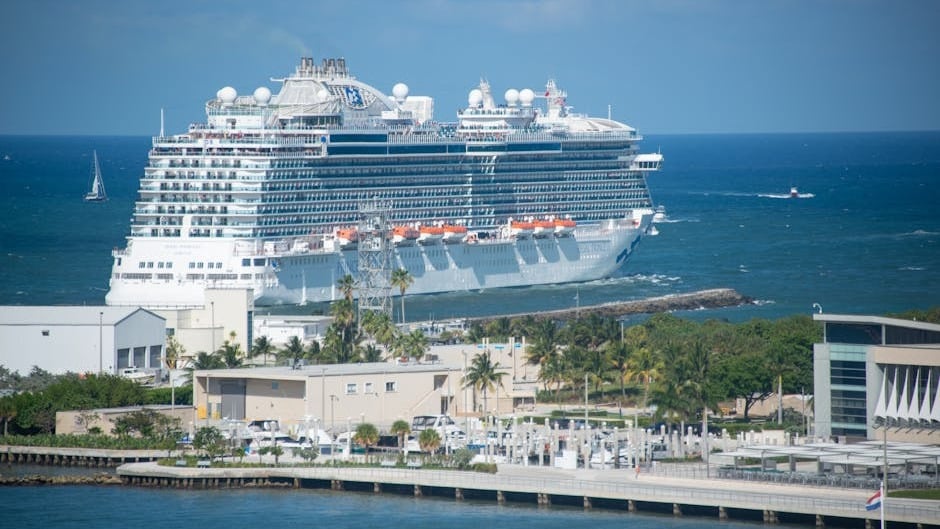
Port Canaveral’s next major cruise terminal will not belong to one line alone. Instead, it is being planned as a shared facility for whichever operators can make the strongest case that they are using their current space efficiently.
That was the message from Port Canaveral CEO Captain John Murray, who said every major cruise line serving Florida’s Space Coast wants access to the port’s planned Cruise Terminal 4. But rather than dedicate the terminal to a single brand, the port intends to run it as a flexible, multi-user facility built for large ships.
Why Everyone Wants the New Terminal
The competition is not hard to understand. Port Canaveral has become one of the most important homeports in the cruise business, and demand for berth space is intense. Cruise lines are continuing to build larger vessels, expand private destination offerings, and plan more short itineraries from Florida. That makes modern terminal space one of the most valuable pieces of infrastructure in the industry.

Photo by Angelo Esposito on Pexels
Murray’s comments suggest the port is in no mood to hand out premium space casually. Access to the new terminal will depend in part on whether cruise lines are fully utilizing the facilities they already have. In other words, the lines asking for more room may first need to prove they are making the best possible use of their existing footprint.
A Shared Terminal, Not a Dedicated One
The new Cruise Terminal 4, currently targeted for completion in 2029, is expected to be used on a shared basis rather than locked into one long-term operator. That approach is not entirely new for Port Canaveral, which already has experience handling multiple cruise brands through the same facility.
Key points
- Terminal 4 is planned as a shared terminal
- No single cruise line is expected to control it exclusively
- It will be reserved for large ships
- The port wants premium infrastructure matched with high-capacity vessels
- Access may depend on current terminal efficiency
- Cruise lines may need to optimize what they already use before gaining more space
- Completion target is 2029
- Expansion is coming, but not immediately
Murray also made clear that the port wants tighter control over how ships are assigned across its network. That matters because not every terminal is equally suited to every vessel, and using a top-tier facility for a smaller ship can limit overall efficiency.
Capacity Is Tight Even at a Top Cruise Port
Port Canaveral is operating close to full capacity across its six terminals. The port recently surpassed PortMiami in annual passenger throughput, making it the busiest cruise port in the world by that measure.
Even with that scale, space remains limited. The port already has infrastructure capable of handling some of the world’s biggest cruise ships, but Murray indicated that not all terminal assignments are maximizing that capability. As more large vessels join fleets, those inefficiencies become harder to ignore.

This is also why long-term agreements matter so much. Cruise lines ordering billion-dollar ships want confidence that they will have somewhere viable to deploy them for many years. From the port’s perspective, however, demand is so high that not every line can get exactly what it wants.
The Bigger Problem May Not Be the Terminal
One of the most important realities facing Port Canaveral is that its most urgent limitation may not be terminal space itself. It may be the roads leading to the port.
Murray pointed to Route 528, the corridor connecting Orlando and Port Canaveral, as a growing choke point. Expansion plans have existed for years, but current state timelines reportedly stretch decades into the future. If traffic worsens faster than infrastructure improves, road congestion could become a more serious obstacle to cruise growth than the shortage of berth space alone.
That is why the port is tying future terminal development to broader transportation upgrades. Murray said the port does not want to keep building if the traffic system around it cannot support the increased volume.
Parking, Hotels, and the Local Economy Are All Part of the Picture
Cruise growth is affecting more than ship schedules alone. Port Canaveral is expanding terminal-related infrastructure such as parking garages, including a new $93 million garage intended to support rising passenger volume. Murray noted that a large majority of cruise guests still arrive by car, making parking a critical part of terminal planning.

Photo by Igor Samoiliuk on Pexels
Beyond that, the surrounding commercial area is changing rapidly. More hotels are being built near the port, and supporting businesses such as shuttle operators and fuel stations also benefit from continued cruise growth. In that sense, the battle over terminal space is not just about ships. It also reflects a wider economic ecosystem that depends on the port’s expansion continuing smoothly.
What This Means for Cruise Lines and Passengers
For cruise lines, Port Canaveral’s position gives it unusual leverage. Multiple brands want the same thing: newer, larger, better-located terminal space in one of the strongest cruise markets in the world. But the port is signaling that access will be managed carefully, not granted automatically.
For passengers, this is a reminder that cruise growth depends on far more than shipbuilding. Terminals, roads, parking, and local infrastructure all shape the experience before anyone even boards. As more lines compete for premium homeport access, those costs and constraints can ripple through the wider business.
Final Takeaway
Port Canaveral’s planned Cruise Terminal 4 is shaping up to be a shared asset rather than a trophy for any single cruise line. That decision reflects just how much demand exists for premium berth space at one of the world’s busiest cruise ports.
The bigger message is that cruise growth in Florida is increasingly becoming an infrastructure story. New ships may grab the headlines, but terminals, highways, parking, and deployment agreements are becoming just as important. And at Port Canaveral, all of those pressures are now colliding in one place.